The Day Master, Defined
A full Saju chart contains eight characters — four pillars of two characters each, drawn from your birth year, month, day, and hour. Out of those eight characters, exactly one represents you. That character is your Day Master (일간, ilgan), and it is the heavenly stem sitting on top of your day pillar.
Everything else in the chart is context. The year stem describes your ancestry and public face, the month branch describes your environment and season, the hour pillar describes your later years and inner life — but the day stem is the subject of the sentence. When a Saju reader says your chart shows conflict, wealth, recognition, or exhaustion, those words are always describing something that happens to your Day Master.
This is why the very first thing a practitioner establishes, before commenting on anything else, is which of the ten heavenly stems occupies the day position. If you only ever learn one fact about your own chart, learn this one.
Why the Day Master Governs Everything Else
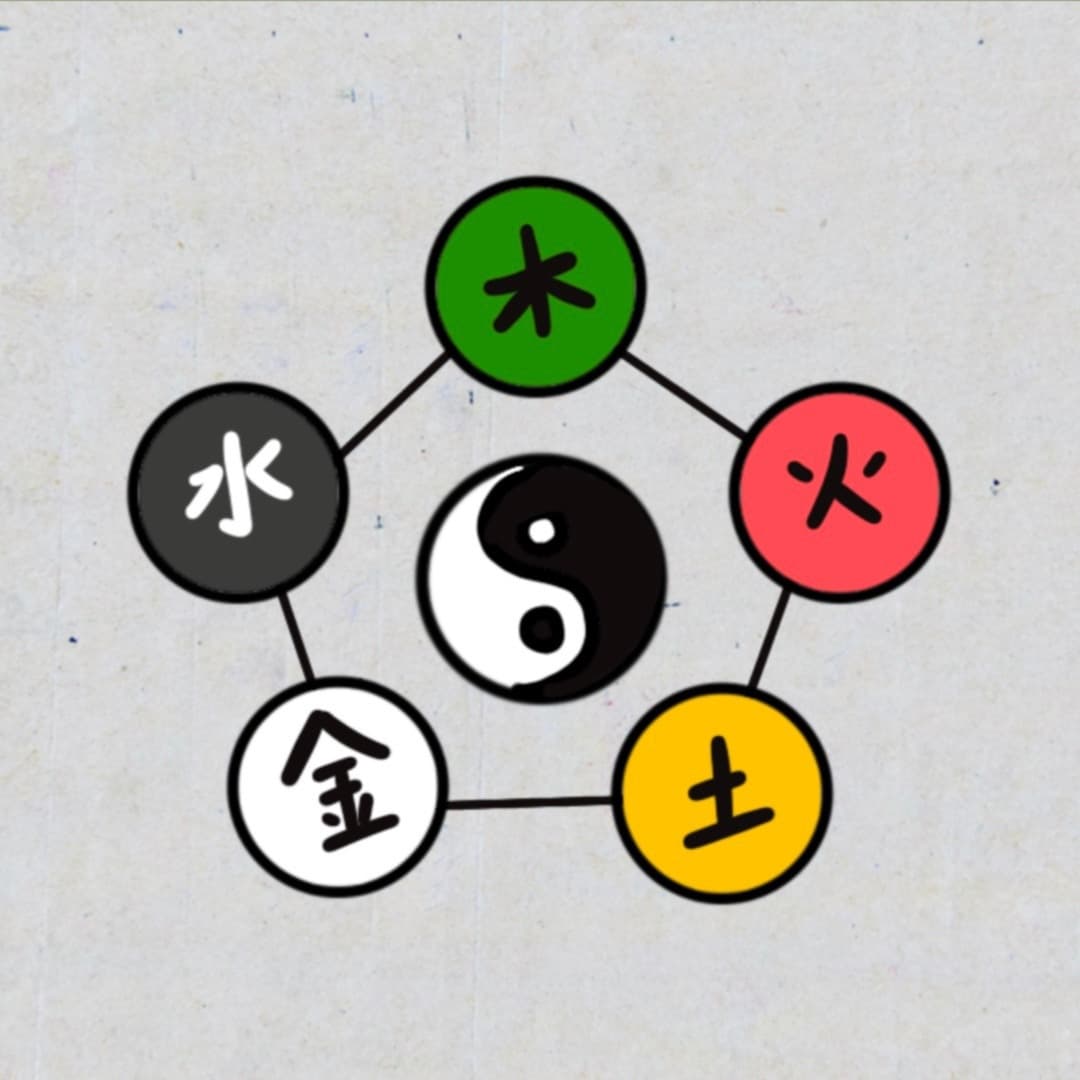
Saju is a relational system, not a list of fixed traits. The Five Elements — Wood, Fire, Earth, Metal, and Water — interact through cycles of generation and control, and those interactions only acquire meaning once you fix a reference point. The Day Master is that reference point.
Consider a chart containing a great deal of Metal. If the Day Master is Wood, that Metal is pressure: Metal cuts Wood, so the chart reads as discipline, obligation, authority, and sometimes strain. If the Day Master is Water, the same Metal is nourishment, because Metal generates Water — it reads as support, mentorship, education, and protection. Identical raw material, opposite meanings, decided entirely by the day stem.
This mechanism is formalized in the Ten Gods (십성, sipseong), the labels that classify every other character in your chart by its relationship to the Day Master — output, wealth, authority, resource, or peer. Without a Day Master there are no Ten Gods, and without the Ten Gods there is no reading. For a full walkthrough of how these layers stack, see our guide on how to read your Saju chart, and for the elemental logic underneath it all, read the Five Elements explained.
The 10 Day Masters
There are ten heavenly stems: five elements, each expressed in a yang (active, outward, expanding) and a yin (receptive, inward, concentrating) form. Classical texts describe each stem through a natural image, and those images are not decoration — they encode how the stem behaves under pressure, what it needs to thrive, and how it relates to the other nine.
Yang Wood (갑, Gap) — The Tall Tree
Gap is the great trunk that grows straight up toward light. Yang Wood people are principled, upward-driving, and structurally honest — they want a clear direction and they want to be first. There is a natural leadership instinct here, along with a certain rigidity: a tree cannot bend far without breaking. Gap does best with a defined goal, room to grow, and a sense that its effort is building something permanent. It struggles with ambiguity, office politics, and being asked to compromise on principle for convenience.
Yin Wood (을, Eul) — The Vine and Flower
Eul is climbing growth: grass, vines, blossoms. Where Gap pushes through obstacles, Eul goes around them. Yin Wood people are flexible, socially perceptive, and remarkably resilient — they survive conditions that would snap a rigid stem. They are skilled at attaching to the right structure and rising with it, which is a genuine strength rather than opportunism. The shadow side is a tendency to depend on external support and to accumulate quiet anxiety when there is nothing solid to climb.
Yang Fire (병, Byeong) — The Sun
Byeong is the sun: impossible to ignore, generous by nature, shining on everyone without discrimination. Yang Fire people are radiant, expressive, warm, and fast — they energize rooms and start things. Their sincerity is usually complete and their moods are visible. The cost of being the sun is that Byeong burns quickly and can scorch what it means to nourish; impatience, over-exposure, and a habit of giving more than is sustainable are the classic Yang Fire patterns.
Yin Fire (정, Jeong) — The Candle
Jeong is contained flame: candlelight, a hearth, a lamp in a dark room. Yin Fire people are warm but focused, devoted rather than broadcast. Their heat is directed at specific people, crafts, and causes, and they sustain it far longer than Yang Fire can. This makes them exceptional in roles requiring care, precision, and long loyalty. A candle is also vulnerable to wind — Jeong is sensitive to environment, prone to inward brooding, and needs protection to keep burning steadily.
Yang Earth (무, Mu) — The Mountain
Mu is the mountain: massive, unmoving, weathering everything. Yang Earth people are steady, trustworthy, and reliably present — the person everyone else leans on during a crisis. They hold value, keep confidences, and rarely act impulsively. The mountain does not turn quickly, though. Mu can be stubborn, slow to update its position, and inclined to carry burdens silently rather than renegotiate them. Its best expression is stewardship: holding something valuable safe over decades.
Yin Earth (기, Gi) — The Field
Gi is cultivated soil: garden earth, farmland, the medium in which things grow. Yin Earth people are nurturing, adaptable, and quietly indispensable — they make other people productive. They absorb tension, mediate between opposing personalities, and adjust to whatever is planted in them. That same receptivity can become a problem: Gi takes on too much, holds other people at its own expense, and can lose its own shape if it never sets a boundary. Fertile soil still needs to be tended.
Yang Metal (경, Gyeong) — The Raw Ore and Axe
Gyeong is unrefined metal: ore, blades, tools. Yang Metal people are decisive, just, and direct — they cut through hesitation and say the thing nobody wants to say. There is a strong internal code here, and a willingness to enforce it. Gyeong is at its best when it has real work to do, because unrefined metal needs Fire to shape it and a task to be aimed at. Idle, it turns blunt or aggressive; its classic failure mode is bluntness mistaken for honesty.
Yin Metal (신, Sin) — The Jewel and Needle
Sin is finished metal: jewelry, a scalpel, a needle. Yin Metal people are refined, precise, and highly attentive to quality — they notice the flaw everyone else missed. They value aesthetics, standards, and reputation, and they tend to be self-demanding to a degree others underestimate. A jewel wants to be seen and kept clean, so Sin is sensitive to criticism and to being handled carelessly. Perfectionism and sharp words are the two edges of the same trait.
Yang Water (임, Im) — The Ocean
Im is the great body of water: sea, river, flood. Yang Water people are ambitious, wise, and free-flowing — broad thinkers who dislike confinement and absorb information from everywhere. They adapt to any container without losing themselves and often carry an unusual capacity for perspective and long strategy. Water in volume also needs banks. Without structure, Im scatters, overcommits, drifts between interests, or floods the situations it moves through.
Yin Water (계, Gye) — The Rain and Dew
Gye is fine water: rain, mist, dew, groundwater. Yin Water people are intuitive, gentle, and quietly penetrating — they sense undercurrents in a room and reach places force cannot. Their influence works by patience and permeation rather than confrontation, which makes them formidable over long horizons and easy to underestimate in the short term. The risk is dispersal: overthinking, emotional absorption of other people, and a tendency to evaporate from situations rather than state a position.
Strong vs Weak Day Master (신강 / 신약)
Once you know your Day Master, the next question a practitioner asks is how much support it receives from the other seven characters. A Day Master surrounded by elements of its own type and by the element that generates it is called strong (신강, singang). One surrounded by elements that drain, control, or consume it is called weak (신약, sinyak).
The single most common misreading in all of Saju is treating strong as good and weak as bad. It is not a score. Strong and weak describe a configuration, and each configuration has its own optimal strategy.
A strong Day Master has surplus energy, and surplus energy needs an outlet. Such charts typically benefit from output (creativity, work, expression), from wealth elements that give the energy somewhere to go, and from authority that provides structure. Left with no outlet, a strong Day Master becomes restless, domineering, or self-defeating — energy with nowhere to discharge turns inward.
A weak Day Master has limited reserves, and limited reserves need reinforcement. Such charts benefit from resource elements (learning, mentors, rest, support systems) and from peer elements (allies, partners, teams). Pushed into constant output without replenishment, a weak Day Master burns out. But a weak Day Master that is properly supported often produces subtle, sophisticated lives — sensitivity and receptivity are advantages in many arenas where raw force is not.
Both configurations can produce exceptional outcomes, and both can produce difficult ones. What matters is whether the chart, and the luck cycles moving through it, supply what that particular configuration needs.
How Your Birth Month Changes Everything
Of all eight characters, the one with the largest single influence on your Day Master is the earthly branch of the month pillar — the season you were born into. In classical practice this is called deukryeong (득령), obtaining the command of the season, and it carries more weight than any other supporting factor.
The reasoning is elemental. Wood is at its peak in spring, Fire in summer, Metal in autumn, and Water in winter, with Earth strongest in the transitional periods at the end of each season. A Yang Wood Day Master born in a spring month arrives with the season behind it and starts strong. The same Yang Wood Day Master born in an autumn month — the season of Metal, which cuts Wood — arrives into headwind, and the entire reading changes: what it needs, what drains it, which decades will feel like expansion and which will feel like consolidation.
This is why generic descriptions of Day Masters can only take you so far. Ten Day Masters multiplied by twelve birth month branches produce 120 distinct starting configurations, and the difference between two of them is not cosmetic. It is the difference between a chart that needs to be fed and a chart that needs to be released.
Note also that Saju month boundaries follow the solar terms of the traditional East Asian calendar, not the Western calendar. The month pillar changes around the 4th to 8th of each Western month, so anyone born near the start of a month should have their chart calculated rather than assumed.
Explore Your Day Master and Birth Month Combination
We have published a dedicated page for every one of the 120 combinations — each Day Master paired with each of the twelve birth month branches — covering seasonal strength, what that specific pairing needs to thrive, natural career directions, and relationship tendencies.
Explore your Day Master and birth month combination →
A few examples of what those pages look like:
- Yang Wood born in Rat month — a tall tree in deep winter water, rich in resource but short on warmth.
- Yin Fire born in Horse month — a candle at the height of summer, brilliant and at risk of over-burning.
If you do not yet know which of the 120 applies to you, calculate your chart first — it takes about thirty seconds.
How to Find Your Own Day Master
Your Day Master cannot be derived from the Western calendar by arithmetic you can do in your head. The day pillar advances through the 60-unit sexagenary cycle (60갑자) continuously, independent of month and year boundaries, so identifying it requires either a traditional almanac (만세력) or a calculator that implements the conversion correctly.
Two details are worth knowing before you calculate:
- Birth time matters at the boundary. Korean practice applies the yajasi (야자시) convention around midnight, meaning a birth between roughly 23:30 and 00:29 may keep the previous day pillar while taking the next day hour pillar. If you were born late at night, use a calculator that handles this rather than assuming the date on your birth certificate.
- Daylight saving time can shift your chart. Korea observed DST in 1949–1960 and again in 1987–1988. Births during those windows need a one hour correction applied before the pillars are calculated, which can move both the hour and, at the boundary, the day.
Our free calculator handles both cases automatically. Enter your birth date and time and it will build all four pillars, label your Day Master, and show the elemental balance of your chart.
Frequently Asked Questions
How do I find my day master?
It is the heavenly stem of your day pillar, which comes from the 60 Gapja cycle rather than the Western calendar. Enter your birth date and time into a free Saju calculator and it will identify the day stem for you along with the rest of the chart.
Which day master is best?
None. All ten are neutral starting points with no inherent luck attached. Chart quality comes from balance — whether your Day Master gets what it needs and whether the elements circulate instead of clashing. A well supported Yin Water chart outperforms a poorly balanced Yang Metal chart every time.
Is the day master the same as BaZi's day master?
Technically yes. Korean Saju and Chinese BaZi use the identical ten stems and twelve branches, so Korean 갑 is Chinese 甲. What differs is interpretive emphasis — Korean practice leans heavily on the Ten Gods and on special stars (신살) — and certain calendar conventions such as the midnight hour boundary. For a broader comparison, see our complete guide to Korean Saju.
Does a strong day master mean a strong person?
No. Strong and weak describe elemental support inside the chart, not willpower, character, or likelihood of success. Strong Day Masters need outlets; weak Day Masters need reinforcement. Both produce capable lives when the surrounding conditions match their needs.
Can my day master change over time?
The stem itself is fixed at birth and never changes. What changes is the environment around it: ten year luck cycles (대운) and annual cycles (세운) keep adding new elements, which can move a chart from supported to strained and back. That shifting context is why one decade of your life can feel completely unlike the last.
Find Your Day Master in 30 Seconds
Enter your birth date and time to build your full Four Pillars chart, identify your Day Master, and see whether it reads as strong or weak — free, no signup required.
Get Your Free Saju Chart