What Is Korean Saju?
Korean Saju (사주) is the traditional Korean system for reading a person's life through the exact moment of their birth. Its full name is Saju Palja (사주팔자), which translates as "Four Pillars, Eight Characters." Your birth year, month, day, and hour each become a pillar, and each pillar carries two characters. Four pillars, eight characters, one chart.
What makes Korean Saju different from a horoscope is that nothing in it depends on where the planets were. The chart is built from a calendar system, not a sky map. Time itself carries elemental quality in this tradition, and your birth moment simply records which qualities were active when you arrived. A Korean Saju reading then asks a structural question: given this particular mix of Wood, Fire, Earth, Metal, and Water, what kind of person tends to emerge, and what conditions help or hinder them?
If you are completely new to the topic, our primer on what Saju is covers the basics in a shorter format. This guide goes deeper and serves as the hub for everything else on the subject.
A 1,400-Year History in Korea
The stem-and-branch calendar underlying Korean Saju originated in China and reached the Korean peninsula more than 1,400 years ago, during the Three Kingdoms and Unified Silla periods. It arrived alongside other imported systems of learning, including astronomy, medicine, and the state calendar that governed agriculture and ritual.
Through the Goryeo dynasty the practice became institutionalized. Court astronomers and calendar officials held formal government posts, and the same body of knowledge used to set the national calendar was applied to individual destinies. During the Joseon dynasty the tradition spread well beyond the court. Scholars studied it as part of a broader Confucian and cosmological education, and ordinary families consulted practitioners before marriages and moves.
Over those centuries Korean Saju drifted away from its Chinese source in meaningful ways. Korean practitioners developed their own emphases, their own interpretive vocabulary, and their own set of customary applications. Two people can compute an identical chart in Seoul and in Taipei and receive two quite different readings, because the analytical priorities are not the same. Korean Saju is a distinct tradition that happens to share a technical foundation with its neighbors.
How the Four Pillars Work
Every Korean Saju chart is built from two sets of symbols: the 10 Heavenly Stems (천간, Cheongan) and the 12 Earthly Branches (지지, Jiji). Pair one stem with one branch and you get a unit. Cycle both lists together and they realign after 60 combinations, producing the Sexagenary Cycle (60갑자, 60 Gapja) used across East Asia to number years, months, days, and hours.
Your birth moment lands on four points in that cycle, one for each pillar. Each pillar governs a different domain of life.
Year Pillar
Represents ancestry, family background, and your outward social identity. The Earthly Branch here is the animal sign Koreans call your tti (띠), the one piece of Korean Saju almost everyone knows by heart.
Month Pillar
Represents parents, upbringing, and professional life. This pillar is set by the solar terms of the traditional East Asian calendar rather than by Western calendar months, which is why someone born on February 3rd and someone born on February 5th can sit in different months entirely.
Day Pillar
Represents you. The day pillar is the anchor of the whole chart, and its stem is your Day Master. The branch of the day pillar traditionally speaks to your spouse and closest partnership.
Hour Pillar
Represents later life, children, and private ambition. Each branch covers a two-hour block, so an accurate birth time matters here more than anywhere else. Korean practice also has specific rules for births near midnight, which shift the boundary in ways a generic calculator often gets wrong.
For a walkthrough of reading an actual chart line by line, see how to read your Saju chart.
The Five Elements
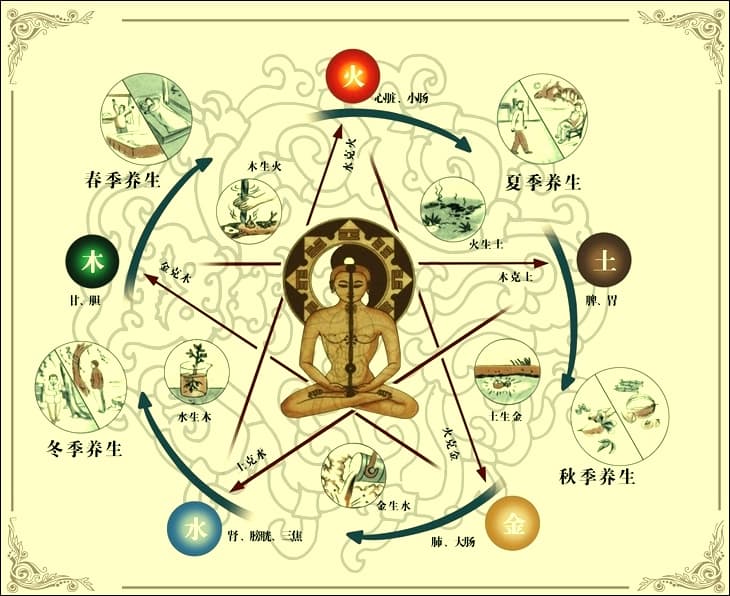
Underneath the stems and branches sit the Five Elements (오행, Ohaeng): Wood, Fire, Earth, Metal, and Water. Every one of your eight characters carries an elemental charge, and the distribution of those charges is the first thing a Korean Saju reading looks at.
The elements relate to each other in two directions. In the generating cycle, Wood feeds Fire, Fire produces Earth, Earth yields Metal, Metal collects Water, and Water nourishes Wood. In the controlling cycle, Wood breaks Earth, Earth dams Water, Water quenches Fire, Fire melts Metal, and Metal cuts Wood. A chart is rarely balanced. Most people have two or three elements crowding the chart and one or two nearly missing, and that imbalance is where the interpretation lives.
A chart heavy in Metal with almost no Fire reads very differently from the reverse, even if both belong to people born the same year. Our guide to the Five Elements breaks down what each element means in practice and how excess or scarcity shows up in personality.
The Day Master: Your Center of Gravity
The single most important character in a Korean Saju chart is the Heavenly Stem of your day pillar, known as the Day Master (일간, Ilgan). It represents you, and everything else in the chart is read relative to it.
There are ten possible Day Masters, one for each Heavenly Stem: five elements in Yang and Yin form. Yang Wood is described as a standing tree, upright and slow to bend. Yin Wood is a vine, flexible and persistent. Yang Fire is the sun, broad and visible. Yin Fire is a candle, focused and intimate. The imagery is not decoration. It encodes how that energy tends to behave under pressure.
The second question a practitioner asks is whether your Day Master is strong or weak within its own chart, meaning whether the surrounding characters support it or drain it. A strong Yang Fire Day Master and a weak Yang Fire Day Master will receive nearly opposite advice about which elements to seek out. This is why generic element descriptions found online tend to disappoint. Without the strength assessment, the reading has no direction. You can look up your own at our Day Master reference.
The Ten Gods (Sipseong)
Once the Day Master is fixed, every other character in the chart takes on a relational role. There are ten such roles, called the Ten Gods (십성, Sipseong), and they are generated by two questions: does this element generate, drain, control, or match my Day Master, and does it share the same Yin or Yang polarity?
The results group into five pairs. Resource types describe learning, mentorship, and support. Output types describe creativity, expression, and what you produce. Wealth types describe money, resources, and in a traditional reading a man's spouse. Officer types describe authority, structure, and career pressure. Peer types describe siblings, colleagues, and competition.
Korean Saju leans on the Ten Gods more heavily than most neighboring traditions. When a Korean practitioner says someone has a career built for organizations rather than for independence, the statement usually traces back to a dominant Officer presence and a thin Output presence. The Ten Gods are what turn an abstract elemental chart into concrete statements about work, money, and family.
Daeun: The 10-Year Luck Cycles
A birth chart is static. Life is not. Korean Saju handles this with Daeun (대운), a sequence of 10-year periods that each layer a new stem and branch on top of your natal chart.
Your Daeun sequence is calculated from the month pillar and moves forward or backward depending on your birth year polarity and gender. The starting age varies from person to person, which is why two people born days apart can enter their cycles at different ages. Each Daeun period temporarily changes the elemental balance of your chart, strengthening what was scarce or worsening what was already excessive.
This is the mechanism behind one of the most common observations in Korean Saju: that a person's life seems to change character every decade or so. A weak Day Master entering a decade of supportive elements often experiences it as a long stretch where effort finally converts into results. The same person entering a draining decade may work just as hard for less. On top of Daeun sits Seun (세운), the annual cycle, which adds the shorter rhythm within each 10-year block.
How Korean Saju Is Used in Modern Korea
Korean Saju is not a museum piece. It operates inside ordinary decisions, often quietly, and often alongside entirely modern reasoning.
Wedding Dates
Choosing an auspicious date (택일, Taegil) remains common practice for Korean weddings, especially when older family members are involved. A practitioner examines both partners' charts and proposes dates whose elemental character supports the couple rather than clashing with either one.
Baby Naming
Korean naming practice (작명, Jakmyeong) often begins with the newborn's Saju chart. If the chart is short on Water, a name whose Chinese characters carry Water energy is chosen to compensate. Professional naming services are a real industry in Korea for exactly this reason.
Career and Business Decisions
People consult Korean Saju before changing jobs, launching a business, or committing to a large investment. The question asked is usually about timing rather than about whether the venture is good in the abstract. Daeun and Seun analysis is the tool of choice here.
Compatibility
Gunghap (궁합), the compatibility reading between two charts, is the most socially visible use of Korean Saju. It is standard before marriage in many families, and it extends well beyond romance. Business partners, co-founders, and even parent-child relationships get read the same way, as covered in Saju compatibility beyond romance.
Get Your Korean Saju Chart
Enter your birth date and time to see your four pillars, your Day Master, your Five Element balance, and your Daeun cycles. Free, in English, no account needed.
Get Your Free Korean Saju ReadingKorean Saju vs Chinese BaZi vs Western Astrology
Korean Saju and Chinese BaZi are technical siblings. Both use the same 10 stems, 12 branches, and Five Elements, and the raw eight characters are frequently identical. The divergence is interpretive. Korean practice gives more weight to the Ten Gods and to Daeun timing, applies its own conventions for calendar edge cases, and carries a distinct set of cultural applications that developed on the peninsula. The comparison is laid out in detail in Chinese astrology vs Korean Saju.
Western astrology is a different instrument altogether. It reads the positions of planets against the zodiac at your birth moment and interprets their geometric relationships. Korean Saju reads no celestial positions at all. Where a Western chart might describe an internal tension between two planetary placements, Korean Saju would describe a specific element overwhelming another and would then name a compensating element to seek out. Both aim at self-knowledge and arrive by unrelated routes, which is explored in Saju vs Western astrology.
How to Get Your Own Korean Saju Reading
You need three things: your birth date, your birth time, and whether that date is solar or lunar. Older Korean records and family documents frequently use the lunar calendar, so if your date came from a Korean family register, confirm which one it is before calculating. A lunar date entered as solar produces a completely different chart.
Birth time matters more than most people expect. Each Earthly Branch spans two hours, so knowing your approximate window is usually enough. If you have no birth time at all, a Korean Saju reading still works from three pillars, but the hour pillar readings about later life and children should be treated as unavailable rather than guessed.
Traditionally you would visit a practitioner, who would compute the chart by hand from a calendar almanac and interpret it in conversation. That is still available in Korea. What has changed is that the computation, once the slow part, is now instant, and the interpretation can be delivered in English to anyone with a browser.
Frequently Asked Questions
What is Korean Saju?
Korean Saju, fully Saju Palja (사주팔자), means "Four Pillars, Eight Characters." It converts your birth year, month, day, and hour into four pairs of characters drawn from the 10 Heavenly Stems and 12 Earthly Branches. Practitioners read the Five Element balance across those eight characters to describe personality, relationships, career direction, and the timing of life events.
Do I need my exact birth time for a Korean Saju reading?
Your birth time sets the hour pillar. Without it you still get a usable reading from the year, month, and day pillars, and your Day Master is unaffected. But conclusions about later life, children, and private motivation lose precision. An approximate two-hour window is generally sufficient, since each branch covers two hours.
Is Korean Saju the same as Chinese BaZi?
They share a technical foundation, so the computed chart is often identical. The interpretive traditions differ. Korean Saju emphasizes the Ten Gods and Daeun cycles, follows its own calendar conventions, and is embedded in Korean cultural practices such as wedding date selection and name selection.
Does Korean Saju mean my fate is fixed?
Most Korean practitioners would say no. The chart describes tendencies and timing, not a script. It tells you which elements you carry in surplus and which you lack, and the Daeun cycles tell you when conditions favor or resist a given move. What you do with that information is not written anywhere in the chart.
Can Korean Saju be read in English?
Yes. The underlying system is mathematical, so the chart itself is language-independent. What has historically blocked non-Korean readers is the interpretation, which relies on dense technical vocabulary. Modern Korean Saju services handle both the calculation and the translation, producing readings in English that keep the original analytical structure intact.
Start with Your Own Chart
Reading about Korean Saju only goes so far. The system becomes concrete the moment you see your own eight characters and find out which element you are short on.
Calculate My Korean Saju