What the Four Pillars of Destiny Actually Is
The Four Pillars of Destiny is a system of East Asian astrology that converts the exact moment of your birth into eight symbols, then reads the relationships between them. It is not a horoscope you look up in a table. It is a small structured chart, unique to your birth minute, that practitioners analyse the way a doctor reads bloodwork — by looking at what is abundant, what is missing, and what is fighting what.
The mechanics are simple to state. Four units of your birth data — the year, the month, the day, and the hour — each become one "pillar." Each pillar is written as two characters stacked on top of each other: an upper character called a Heavenly Stem and a lower character called an Earthly Branch. Four pillars times two characters equals eight characters total. That is the entire chart.
This is why the Chinese name for the system is BaZi (八字), meaning literally "eight characters," and why the Korean name is Saju Palja (사주팔자), meaning "four pillars, eight characters." English-language books settled on the more evocative translation "Four Pillars of Destiny," and that is the name most Western readers meet first. All three terms describe the same eight symbols.
One System, Three Living Traditions
The Four Pillars method took its recognisable modern shape in China during the Tang and Song dynasties, when the reference point of the chart shifted from the year pillar to the day pillar — a reform usually credited to the scholar Xu Ziping. From there the system travelled outward across the Sinosphere and rooted itself in three places that still practise it today.
Chinese BaZi is the largest and most technically documented tradition. It leans heavily on the concept of the useful god (the element the chart most needs to come into balance) and on formal structural classifications of chart types.
Korean Saju received the system by roughly the Goryeo period and developed a distinct interpretive school over the following centuries. Korean practice tends to put more weight on the Ten Gods as a portrait of relationships and social role, on sinsal(special star combinations attached to particular branch pairings), and on reading the chart conversationally as a life narrative rather than as a technical classification exercise. Korean readings also fold in adjustments unique to the peninsula's calendar and time history, such as corrections for Korea's standard-meridian changes and daylight saving periods. If you want the Korean framing in full, our introduction to Saju and the longer complete guide to Korean Sajugo deeper.
Japanese Shichusuimei (四柱推命) is the third branch, formalised in Japan during the Edo period. It shares the same eight characters but developed its own vocabulary and its own emphasis on the twelve life stages.
None of these traditions is a corruption of the others. They are dialects of one grammar. If you are weighing which framing suits you, our comparison of Chinese astrology versus Korean Saju lays out the practical differences.
What Each of the Four Pillars Governs
The pillars are not four repetitions of the same information. Each covers a different domain of life, and they are conventionally read in the order below — outward-facing first, innermost last.
Year Pillar — Ancestry and Social Persona
The year pillar describes the inherited layer of your life: family line, ancestral conditions, the generational climate you were born into, and the face you present to society at large. It is the pillar strangers meet. In Korea the branch of this pillar is your tti (띠), your zodiac animal — the one piece of the chart nearly everyone knows about themselves. Because it is only one of eight characters, though, judging a person by their animal alone is like judging a sentence by its first letter.
Month Pillar — Career, Parents, and Inner Environment
The month pillar is the workhorse of the chart. It represents your parents and upbringing, the environment that formed your habits, and your professional life and social standing in adulthood. Technically it also matters more than the others, because the month branch establishes the seasonal energy of the whole chart — it tells you which element is in season and therefore strong, and which is out of season and therefore weak. A Wood Day Master born in spring and one born in autumn are entirely different people despite sharing the same day pillar.
One thing surprises beginners here: the month pillar does not follow calendar months. It follows the twenty-four solar terms, the traditional East Asian division of the solar year. The Four Pillars "month" begins at a solar term, not on the first of the month, so someone born on 4 February may belong to the previous month's pillar or the next one depending on the exact hour the term begins that year.
Day Pillar — The Self and the Spouse
The day pillar is the centre of the chart. Its upper character — the Heavenly Stem — is your Day Master, the symbol that represents you. Every other character in the chart is interpreted by how it relates to this one. The lower character, the day branch, is conventionally called the spouse palace and describes your marriage, your closest partnership, and the private domestic self only intimates see.
Hour Pillar — Children, Later Life, and Private Self
The hour pillar covers your children, your later years, and the motivations you do not announce: hidden ambitions, creative drives, what you actually want when nobody is watching. It is also the pillar most often missing, because birth times go unrecorded far more often than birth dates.
Heavenly Stems and Earthly Branches
The eight characters are drawn from two fixed alphabets. Ten Heavenly Stems(천간, cheongan) and twelve Earthly Branches (지지, jiji). Pairing them in sequence produces sixty unique combinations before the cycle repeats — the sexagenary cycle, known in Korean as the 60 Gapja (60갑자). This sixty-unit cycle has been used to number years, months, days and hours across East Asia for well over two thousand years, which is precisely why the system works: the calendar itself is already written in the notation the chart needs.
The ten Heavenly Stems are the five elements in their Yang and Yin forms:
- Gap (갑) / Eul (을) — Yang Wood and Yin Wood
- Byeong (병) / Jeong (정) — Yang Fire and Yin Fire
- Mu (무) / Gi (기) — Yang Earth and Yin Earth
- Gyeong (경) / Sin (신) — Yang Metal and Yin Metal
- Im (임) / Gye (계) — Yang Water and Yin Water
The twelve Earthly Branches are the familiar zodiac animals — Rat, Ox, Tiger, Rabbit, Dragon, Snake, Horse, Goat, Monkey, Rooster, Dog, Pig — but in a Four Pillars reading the animal is almost incidental. What matters is that each branch carries an element, a season, a compass direction, a two-hour slice of the day, and one to three hidden stems: additional elements concealed inside the branch that participate quietly in the chart's balance. Hidden stems are the main reason two charts that look similar on the surface can read very differently.
The Five Elements and Yin-Yang: The Underlying Grammar
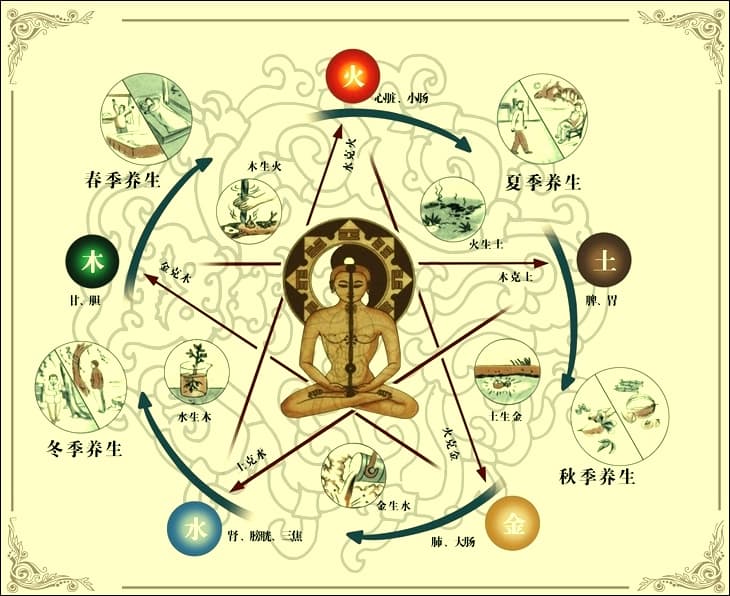
Every one of the eight characters resolves to one of five elements — Wood, Fire, Earth, Metal, Water — in either Yang (active, outward, expanding) or Yin (receptive, inward, consolidating) polarity. The elements are not static categories. They act on each other through two cycles that a beginner should memorise before anything else.
The generating cycle: Wood feeds Fire, Fire produces Earth (ash), Earth yields Metal (ore), Metal collects Water (condensation), Water grows Wood. Each element strengthens the next.
The controlling cycle: Wood breaks Earth, Earth dams Water, Water quenches Fire, Fire melts Metal, Metal cuts Wood. Each element restrains another.
A Four Pillars reading is fundamentally an audit of these two cycles inside your eight characters. Which elements are abundant? Which are absent? Is your Day Master supported by allies or surrounded by things that drain and control it? Nearly every conclusion in a reading traces back to that arithmetic. Our guide to the five elements works through the cycles with examples.
The Day Master: The Chart's Centre of Gravity
If you remember one term from this article, make it this one. The Day Master(일간, ilgan) is the Heavenly Stem of your day pillar, and it stands for you. There are exactly ten possible Day Masters, one per stem, and each carries a recognisable temperament — Yang Wood as the upright tree that grows straight and resists bending, Yin Water as the stream that finds any opening, Yang Metal as the blade that values decisiveness over comfort.
But the Day Master's character is only half the story. The other half is its strength: whether the surrounding seven characters support it or deplete it. A strong Day Master has too much of itself and benefits from outlets — work, output, expenditure of energy. A weak Day Master needs resources and allies before it can spend. This single judgement steers most of the practical advice a reading produces, from career direction to which years will feel easy. Our Day Master guide covers all ten types.
See Your Own Four Pillars
You cannot follow any of this in the abstract for long. Generate your own eight characters — free, no account needed — and read the rest of this article with your chart in front of you.
Get Your Free Four Pillars ChartThe Ten Gods: Turning Elements into Human Roles
Raw elements do not tell you about relationships or money. The Ten Gods(십성, sipseong) do. Each of the other seven characters is labelled by its relationship to your Day Master, producing ten possible roles that group into five pairs:
- Companions (Friend, Rob Wealth) — peers, siblings, rivals, competition
- Output (Eating God, Hurting Officer) — creativity, expression, performance, children
- Wealth (Direct Wealth, Indirect Wealth) — income, assets, opportunity, and in a man's chart the spouse
- Officer (Direct Officer, Seven Killings) — authority, discipline, pressure, career structure, and in a woman's chart the spouse
- Resource (Direct Resource, Indirect Resource) — learning, support, mothers, protection
This translation layer is what turns an elemental audit into a readable portrait. A chart heavy in Output and light in Officer describes someone expressive who chafes under supervision. A chart dense with Resource and thin on Wealth describes someone who accumulates knowledge more readily than money. Korean Saju leans on this layer especially hard, which is part of why Korean readings feel more like character studies than technical reports.
Luck Pillars: Destiny as Timing, Not Verdict
The birth chart is fixed. Life is not. The bridge between them is the luck pillarcycle — daeun (대운) in Korean, dayun in Chinese — a sequence of ten-year periods, each of which adds one more stem-and-branch pair to your chart temporarily.
This matters more than most beginners expect. A ten-year luck pillar can pour the exact element your chart was starving for, or flood it with the element it already had too much of. The same person, unchanged in character, can find one decade unusually smooth and the next unusually costly, purely because the elemental environment shifted around a static chart. Layered on top are annual pillars (세운, seun), which apply the same logic year by year.
This is the sense in which Four Pillars talks about "destiny." It is not a script of events. It is a map of when your existing tendencies will be supported and when they will meet friction — which is far more actionable than a prophecy. Knowing that a difficult decade is structural rather than personal failure changes how you plan through it.
What a Four Pillars Reading Can and Cannot Tell You
A good reading is specific about its own limits. Here is an honest boundary.
It can describe your temperament and default reactions with unusual precision; identify which element your chart lacks and what compensating behaviour that produces; show which life domains carry structural tension; indicate favourable and unfavourable periods over decades; and compare two charts for compatibility by checking whether one supplies what the other lacks.
It cannot name specific events, dates, or people. It cannot tell you whether you will get a particular job or meet a particular person. It does not override choice, effort, or circumstance — two people with identical charts born in different countries to different families lead entirely different lives. And it should never be used to make medical, legal or financial decisions.
The useful posture is to treat a Four Pillars chart as a well-structured mirror. It tells you what you are working with. What you build with it is not in the chart.
How to Get Your Own Four Pillars Chart
You need three things: your birth date, your birth time (as precise as you can manage), and your birth location. Location matters because the chart runs on true local time, and modern time zones can differ from solar time by a meaningful margin — enough to shift an hour pillar across a boundary.
Historically, casting a chart by hand meant consulting a manse almanac and doing the conversions yourself, which is why readings were the preserve of specialists. A calculator does the same arithmetic in a second, including the solar-term boundaries, the sexagenary conversion, the hidden stems, the Ten Gods mapping and the luck-pillar sequence.
Once you have your chart, read it in this order: find your Day Master, judge whether it is strong or weak, count your five elements to find the excess and the gap, then read the Ten Gods for the human story. That sequence is how a practitioner works, and it keeps you from getting lost in the symbols.
Frequently Asked Questions
Is Four Pillars of Destiny the same as BaZi?
Yes. "Four Pillars of Destiny" is the standard English translation of the Chinese term BaZi ("eight characters") and of the Korean Saju Palja. All three name the same chart. What differs is the interpretive school reading it — Chinese BaZi, Korean Saju and Japanese Shichusuimei share the eight characters but emphasise different techniques and produce differently flavoured readings.
Is a Four Pillars reading accurate?
The calculation is deterministic: identical birth data always yields identical characters, so there is nothing to be inaccurate about at that stage. Accuracy is a question about interpretation. Treated as a structured model of temperament and timing, Four Pillars is strikingly consistent — readers who have never met you will describe the same tendencies from the same chart. Treated as event prediction, it overreaches, and any reading that promises specific outcomes is selling certainty it does not have.
What if I do not know my birth hour?
Work with three pillars. Your year, month and day pillars — including your Day Master, the most important single character — need only the date. You lose the hour pillar, so conclusions about children, later life and private motivation become unavailable, and a few techniques lose precision. Do not guess. A wrong hour actively corrupts the reading, while a missing hour merely narrows it.
Do I need my lunar birthday?
No. Despite the association with the lunar calendar, the Four Pillars system is solar — the month pillar is set by the twenty-four solar terms, which track the sun. Enter your ordinary Gregorian birth date. A good calculator will accept a lunar date and convert it, but solar input avoids leap-month ambiguity.
How is this different from Western astrology?
Western astrology is astronomical: it maps planets against constellations at a moment in space. Four Pillars uses no planets and no sky map at all. It converts calendar time into elemental symbols and analyses how those symbols generate and control one another. Where Western astrology would call you "a Scorpio with Leo rising," Four Pillars would call you "a weak Yin Water Day Master born in summer with excess Fire" — and then tell you which decade fixes that.
Ready to Read Your Own Chart?
Enter your birth details and get your Four Pillars chart with a full Korean Saju interpretation — Day Master, five-element balance, Ten Gods and luck pillars included. Free to start.
Get Your Free Four Pillars Reading